
Cupid Astride an Eagle
n.d.
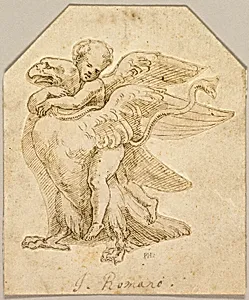
Medium
Pen and brown ink, with brush and brown wash, over traces of black chalk, on buff laid paper, laid down on cream laid paper
Dimensions
12.4 × 10.4 cm (4 15/16 × 4 1/8 in.)
Classification
ink with wash
Department
Prints and Drawings
Museum
Art Institute of Chicago
Accession Number
49312
Rights
Public Domain
Art Historical Context
Behold the whimsical *Cupid Astride an Eagle*, a delicate drawing by Giulio Romano (c. 1499–1546), one of the Renaissance's most inventive Mannerist artists. A favored pupil of Raphael, Romano blended classical mythology with dynamic, elegant forms, influencing generations from Rome to Mantua. Created in pen and brown ink with brush and brown wash over faint black chalk traces, this undated study on buff laid paper (12.4 × 10.4 cm) captures Cupid's playful perch on a soaring eagle—a nod to ancient tales of love's triumphant flight, infused with Romano's characteristic grace and subtle eroticism. The mixed-media technique exemplifies 16th-century draftsmanship: the precise ink lines define contours and feathers, while translucent washes add volume and shadow, evoking three-dimensionality on a tiny scale. Such preparatory sketches were prized by collectors for their spontaneity, often serving as models for larger paintings, frescoes, or engravings. Romano's fluid style, with its elongated figures and rhythmic motion, bridges High Renaissance harmony and Mannerist exaggeration. Housed in the Art Institute of Chicago's Prints and Drawings collection, this gem invites us to marvel at the intimacy of an artist's hand. Up close, the layered papers and subtle buffs reveal the care of centuries-old preservation, offering a window into the creative fervor of the Italian Renaissance.
About the Artist
Giulio Romano · 1499–1546
Giulio Romano (c. 1499–1546) was the most gifted pupil of Raphael and one of the founding figures of Mannerism, the style that succeeded the High Renaissance in Italy. Born Giulio Pippi in Rome, he entered Raphael's workshop as a boy and proved so talented that by the time of Raphael's death in 1520 he was effectively running the studio and overseeing the completion of major unfinished commissions...