
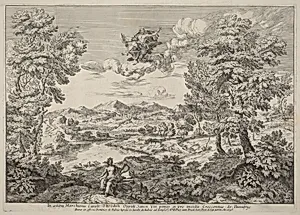
Jupiter in a Landscape
Medium
etching
Dimensions
plate: 32 x 44.7 cm (12 5/8 x 17 5/8 in.) sheet: 34.8 x 50 cm (13 11/16 x 19 11/16 in.)
Classification
Department
CG-E
Museum
National Gallery of Art, Washington, D.C.
Credit
Ailsa Mellon Bruce Fund
Accession Number
1985.3.17
Rights
Public Domain
Art Historical Context
Behold *Jupiter in a Landscape* (1696), a captivating etching by the Italian artist Crescenz Onofri (c. 1634–1712), now housed in the National Gallery of Art. This print measures a generous plate size of 32 x 44.7 cm, inviting viewers into a mythical realm where the king of the gods, Jupiter, presides amid a sprawling natural vista. Onofri, a Roman etcher active in the late Baroque era, drew inspiration from classical mythology, blending divine grandeur with earthy landscapes—a nod to the era's fascination with antiquity revived through art. Created during the height of Baroque printmaking, the work exemplifies etching's revolutionary technique: acid biting into a copper plate to etch intricate lines, allowing for rich tonal contrasts and fluid details far beyond woodcuts. This method democratized grand artistic visions, enabling wider dissemination of elaborate scenes like this one, where Jupiter's imposing form likely commands thunderous skies or pastoral expanses, evoking the dramatic movement and emotional intensity of 17th-century Italian art. Onofri's piece reflects the cultural zeitgeist of late 1600s Rome, where mythology intertwined with nature to celebrate human imagination against divine power. A gem from the Ailsa Mellon Bruce Fund, it offers modern visitors a window into Baroque mastery—perfect for pondering the gods among us.
About the Artist
Crescenzio Onofri · 1632–1712
Comment on works: Landscapes