
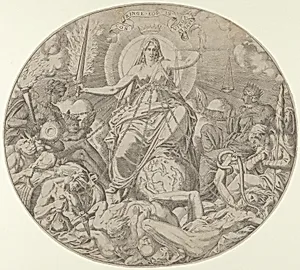
Justice, frontispiece from the "Seven Deadly Sins"
ca. 1550–55
Medium
Etching
Dimensions
Sheet (trimmed/oval): 10 5/16 × 11 9/16 in. (26.2 × 29.4 cm)
Classification
Prints
Department
Drawings and Prints
Museum
Metropolitan Museum of Art, New York, NY
Credit
The Elisha Whittelsey Collection, The Elisha Whittelsey Fund, 1949
Accession Number
49.50.212
Rights
Public Domain
Tags
Art Historical Context
"Justice," an etching by Léon Davent after Luca Penni, dates to around 1550–55 and serves as the striking frontispiece for a series on the Seven Deadly Sins. Created the Mannerist period at the Fontainebleau School in France, this print reflects the era's elegant, elongated figures and intricate symbolism, blending Italian Renaissance influences with French courtly sophistication. Penni, an Italian artist who worked under Francesco Primaticcio, designed the composition, while Davent, a master etcher, brought it to life with fine lines and tonal depth. The central female figure embodies Justice, poised with sword and scales—classic emblems of judgment and balance—amid twisting snakes that evoke vigilance or retribution. These motifs underscore the moral allegory tying virtues to the battle against sin, a popular theme in 16th-century European art meant to instruct and warn viewers. Etching, a relatively new technique at the time, allowed for fluid, expressive lines that captured Mannerism's dynamic energy, making prints like this accessible beyond elite patrons. Housed in the Metropolitan Museum of Art's Drawings and Prints department, this 10⅜ × 11⅝-inch oval sheet exemplifies how Renaissance printmakers democratized complex iconography, inviting reflection on ethics in an age of religious upheaval. (198 words)
About the Artist
Léon Davent|Luca Penni · 1540–1556
**Léon Davent** (also known as Master L.D. or the monogrammist L.D.) was a French printmaker active in the mid-16th century, best known for his work in both engraving and etching. He played a leading role in the printmaking workshop associated with the First School of Fontainebleau at the Palace of Fontainebleau during the 1540s. His prints, often signed simply “L.D.,” reproduced designs by Italia...