
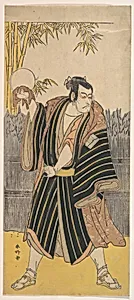
勝川春好画 七代目片岡仁左衛門 五代目市川團十郎|Kabuki Actor Ichikawa Danjūrō V
ca. 1788–90
Medium
One of a diptych of woodblock prints; ink and color on paper
Dimensions
H. 12 7/8 in. (32.7 cm); W. 5 5/8 in. (14.3 cm)
Classification
Prints
Culture & Period
Japan · Edo period (1615–1868)
Department
Asian Art
Museum
Metropolitan Museum of Art, New York, NY
Credit
Fletcher Fund, 1928
Accession Number
JP1494
Tags
Art Historical Context
This exquisite woodblock print by Katsukawa Shunkō created around 1788–90 during Japan's Edo period (1615–1868), captures the dramatic flair of Kabuki theater stars. Titled *Kabuki Actor Ichikawa Danjūrō* (with the Japanese inscription referencing both the seventh-generation Kataoka Nizaemon and-generation Ichikawa Danjūrō), it forms one half of a diptych showcasing these legendary onnagata (male actors specializing in female roles). Measuring just 12⅞ × 5⅝ inches, its narrow hosoban format was ideal for affordable, collectible art that brought theater glamour into everyday homes. Shunkō, a l...
About the Artist
Katsukawa Shunkō
Katsukawa Shunkō I (1743–1812) was a Japanese ukiyo-e artist who pioneered the ōkubi-e (large-head) portrait format in kabuki actor prints and served as possibly the first student of Katsukawa Shunshō, the founder of the influential Katsukawa school. Born in 1743, Shunkō spent his entire life in Edo (modern Tokyo), working as both a painter and ukiyo-e printmaker specializing in yakusha-e (actor p...