
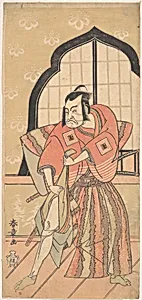
勝川春章画 三代目市川団蔵|Kabuki Actor Ichikawa Danzō III
ca. 1760s
Medium
Woodblock print (nishiki-e); ink and color on paper
Dimensions
12 3/4 x 5 7/8 in. (32.4 x 14.9 cm)
Classification
Prints
Culture & Period
Japan · Edo period (1615–1868)
Department
Asian Art
Museum
Metropolitan Museum of Art, New York, NY
Credit
Purchase, Joseph Pulitzer Bequest, 1918
Accession Number
JP450
Rights
Public Domain
Tags
Art Historical Context
Step into the vibrant world of-period Japan with this striking woodblock print by Katsukawa Shunshō a master of ukiyo-e ("pictures of the floating world"). Titled *Kabuki Actor Ichikawa Danzō III*, created around the 1760s, it captures the third-generation actor in a dynamic pose, likely from a dramatic role involving swords, as suggested by the imagery. Shunshō, founder of the influential Katsukawa school, revolutionizedusha-e (actor prints by emphasizing realistic facial expressions and theatrical intensity, making stars like Danzō accessible to everyday fans. This nishiki-e, or "brocade picture," showcases the pinnacle of woodblock printing innovation: multiple color blocks layered with ink and pigment on paper, yielding rich, jewel-like hues in a compact 12¾ x 5⅞-inch format. During the Edo period (1615–1868), Kabuki theater was a cultural phenomenon, blending music, dance, and swordplay to entertain urban audiences. Prints like this democratized celebrity culture, sold cheaply in theaters and shops, fueling a boom in actor portraits. Acquired by the Metropolitan Museum of Art in 1918 through the Joseph Pulitzer Bequest, this piece from the Asian Art department highlights Shunshō's legacy in bridging art and performance, offering a window into Japan's theatrical golden age.
About the Artist
Katsukawa Shunshō · 1726–1792
Katsukawa Shunshō (1726–1793) revolutionized ukiyo-e printmaking by introducing realistic portraiture to kabuki actor prints, founding the Katsukawa school that would dominate theatrical imagery in late 18th-century Japan. Born in 1726, Shunshō transformed the conventional approach to yakusha-e (actor prints) by depicting performers with individual facial features and genuine likenesses rather tha...