
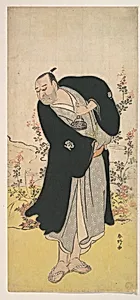
六代目中山小十郎|Kabuki Actor Nakayama Kojūrō VI
1786
Medium
Woodblock print; ink and color on paper
Dimensions
12 5/8 x 5 3/4 in. (32.1 x 14.6 cm)
Classification
Prints
Culture & Period
Japan · Edo period (1615–1868)
Department
Asian Art
Museum
Metropolitan Museum of Art, New York, NY
Credit
Purchase, Joseph Pulitzer Beqeust, 1918
Accession Number
JP275
Rights
Public Domain
Tags
Art Historical Context
This striking woodblock print by Katsukawa Shunkō captures the dynamic presence of Nakayama Kojūrō VI, a celebrated kabuki actor of the late eighteenth century. Created in 1786 during Japan’s Edo period, the work belongs to the rich tradition of yakusha-e, or actor prints, which brought the excitement of the kabuki stage to a broad audience. Shunkō, a leading artist of the Katsukawa school, specialized in these vivid portraits that emphasized dramatic poses and expressive features, helping to popularize individual performers much like celebrity imagery today. Printed with ink and color on paper, the modest vertical format—roughly the size of a modern magazine page—made such works affordable and widely collectible. Kabuki actors were cultural icons whose elaborate costumes and stylized gestures enthralled townspeople, and prints like this one preserved fleeting stage moments for fans across Edo (modern Tokyo). The Metropolitan Museum’s impression, acquired in 1918, offers today’s viewers a direct connection to this vibrant theatrical world. Shunkō’s confident line work and bold use of color highlight both the actor’s commanding stance and the technical brilliance of ukiyo-e printmaking, underscoring the enduring appeal of Japanese popular art.
About the Artist
Katsukawa Shunkō · 1743–1812
Katsukawa Shunkō I (1743–1812) was a Japanese ukiyo-e artist who pioneered the ōkubi-e (large-head) portrait format in kabuki actor prints and served as possibly the first student of Katsukawa Shunshō, the founder of the influential Katsukawa school. Born in 1743, Shunkō spent his entire life in Edo (modern Tokyo), working as both a painter and ukiyo-e printmaker specializing in yakusha-e (actor p...