
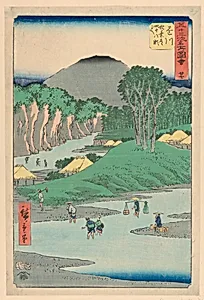
Kakegawa: Foring the Forty-eight Rapids on the Akiba Road (Kanagawa, Akiba michi shijuhachi segoe)
1797-1858
Classification
landscapes
Department
Smithsonian Collection
Museum
Smithsonian American Art Museum
Credit
Gift of the Estate of Mrs. Robert H. Patterson
Accession Number
1941-31-223
Rights
Public Domain
About this artwork
Research in Progress
Art Historical Context
Ando Hiroshige (1797–1858), one of Japan's master ukiyo-e artists captures the dramatic challenges of travel in *Kakegawa: Fording the Forty-eight Rapids the Akiba Road (Kanagawa, Akiba michi shijuhachi segoe)*. This landscape print depicts a perilous river crossing near Kakegawa, a key station on the historic Tōkaidō road—a vital artery connecting Edo (modern Tokyo) to Kyoto the Edo period (1603–1868). Hiroshige's work reflects the era's booming culture of pilgrimage and commerce, where travelers braved rugged terrains like the Akiba Road's rapids. Renowned for his poetic depictions of nature and human endeavor, Hiroige belonged to the ukiyo-e movement, emphasizing fleeting beauty through woodblock prints (though the exact medium here remains under study). His series, such as *The Fifty Stations of the Tōkaidō*, popularized these roadside scenes, blending vivid colors dynamic composition, and atmospheric perspective to evoke motion and mood. This piece highlights the fortitude of porters and pilgrims fording swift waters, a nod to Japan's resilient spirit. Now in the Smithsonian American Art Museum's collection, gifted by the Estate of Mrs. Robert H. Patterson, it invites visitors to ponder the artistry of everyday adventure. Research continues to uncover more about its creation, but Hiroshige's legacy endures in evoking wanderlust across centuries.