
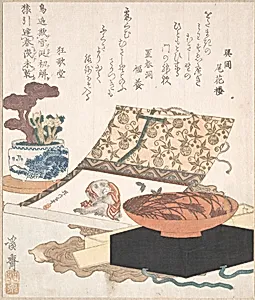
Kakemono of Monkey, Wine Cup and Potted Plants
probably 1812
Medium
Woodblock print (surimono); ink and color on paper
Dimensions
7 3/4 x 6 9/16 in. (19.7 x 16.7 cm)
Classification
Prints
Culture & Period
Japan · Edo period (1615–1868)
Department
Asian Art
Museum
Metropolitan Museum of Art, New York, NY
Credit
H. O. Havemeyer Collection, Bequest of Mrs. H. O. Havemeyer, 1929
Accession Number
JP2220
Rights
Public Domain
Tags
Art Historical Context
In the vibrant world of Edo-period Japan (1615–1868), Keisai Eisen's *Kakemono of Monkey, Wine Cup, andotted Plants* (probably 1812) captures a whimsical moment through the lens of ukiyo-e woodblock printing. Eisen, a master of the genre known for his elegant depictions of courtesans and daily life, here turns to playful motifs: a mischievous monkey reaching for a sake cup amid lush potted plants, evoking the kakemono (hanging scroll) format in miniature. Created during the Water Monkey year of the zodiac, this intimate scene likely delighted patrons with its festive spirit, blending humor and refinement. As a *surimono*—a luxurious, privately commissioned print—this 7 3/4 x 6 9/16-inch work showcases advanced techniques: vibrant inks and colors layered on paper, often with subtle embossing or mica for texture, reserved for elite New Year's greetings or poetry albums. Surimono elevated woodblock printing beyond mass production, emphasizing artistry over commerce and reflecting Japan's sophisticated print culture. Housed in the Metropolitan Museum of Art's H. O. Havemeyer Collection, this piece highlights the enduring appeal of animal symbolism in Japanese art, where monkeys often embodied cleverness and revelry. A charming window into Edo leisure, it invites us to savor the joy in small-scale splendor.
About the Artist
Keisai Eisen · 1790–1848
Keisai Eisen (1790–1848), born Ikeda Yoshinobu in Edo (modern Tokyo), emerged as one of the late Edo period's most prolific ukiyo-e masters. The son of the renowned calligrapher and Kanō-school painter Ikeda Shigeharu, Eisen was immersed in the arts from childhood. He apprenticed under Kanō Hakkeisai, adopting the art name "Keisai" in homage to his teacher, and later studied bijin-ga (images of be...