
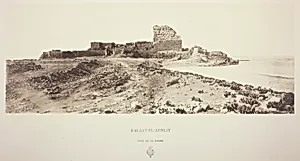
Kalatt-El-Athlit, Côté de la Terre
c. 1860
Medium
Albumen print
Dimensions
Image/paper: 20.8 × 55.4 cm (8 1/4 × 21 13/16 in.); Mount: 45.2 × 60.9 cm (17 13/16 × 24 in.)
Classification
photography
Department
Photography and Media
Museum
Art Institute of Chicago
Accession Number
191265
Rights
Public Domain
Art Historical Context
In the mid-19th century, photographer Louis De Clercq captured the rugged beauty and historical depth of the Middle East during his travels as a naval officer. *Kalatt-El-Athlit, Côté de la Terre (c. 1860) showcases the "land side" of Crusader-era fortress at Athlit, strategic coastal stronghold near modern-day Haifa, Israel. This albumen print, measuring 20.8 × 55.4 cm, preserves the site's imposing stone walls and towers against a stark landscape, offering visitors a window into a medieval bastion that guarded pilgrims and withstood sieges for centuries. As one of the earliest photographic mediums, albumen prints—made by coating paper with egg whites and silver salts—delivered remarkable detail and warm tones, revolutionizing documentary imagery. De Clercq's work exemplifies the era's fervor for Orientalist exploration and archaeology, fueled by European fascination with biblical lands. His panoramic composition highlights the fortress's defensive architecture, blending precise technical mastery with an evocative sense of timeless isolation. Housed in the Art Institute of Chicago's Photography and Media department, this piece underscores photography's role in preserving vanishing antiquities, bridging 19th-century adventure with our enduring curiosity about the Crusades. A testament to De Clercq's pioneering eye, it invites reflection on how light and chemistry immortalized history.