
Kan
after 1902
Medium
rock crystal; mount: gold, enamel
Dimensions
22.3; 8.1; 6; 13.3
Rights
Public Domain
About this artwork
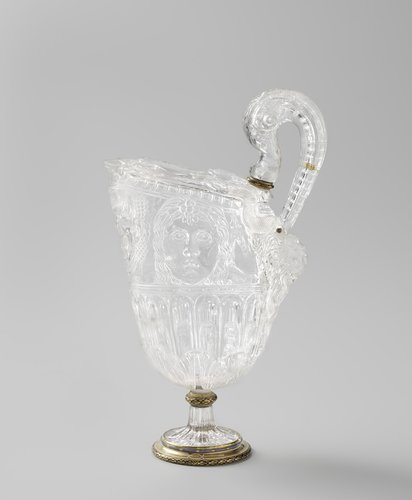
Kan van bergkristal op ronde voet met hoog, gebogen aangezet oor. Montuur van goud met zwart email. Het hoge vat waarvan de voorzijde enigszins tuitvormig oploopt, is ovaal in doorsnede en wordt door een horizontale profielband in twee helften verdeeld.
Art Historical Context
### Kan (Jug) This exquisite anonymous jug, crafted after 1902, showcases the pinnacle of early 20th-century lapary and metalworking arts. Titled *Kan*—Dutch for jug—it features a tall, elegant body of shimmering rock crystal, perched on a round foot with a high, gracefully curved handle. The oval cross-section of the vessel, subtly spout-shaped at the front, is elegantly divided by a horizontal profile, creating a balanced, harmonious form that invites admiration from all angles. Measuring 22.3 cm in height, its dimensions emphasize a sense of refined proportion, perfect for display as a luxurious decorative object. Rock crystal, a prized variety of quartz known for its clarity and brilliance, was meticulously carved here to capture light like fine glass, evoking the natural purity of the material while highlighting the artisan's skill in shaping hard stone. The ornate gold mount, accented with black enamel, adds opulent contrast and protection, a technique common in high-end European jewelry houses of the era. This combination of materials reflects the period's fascination with gemstone vessels, blending ancient lapidary traditions with modern decorative flair, possibly influenced by Art Nouveau's flowing lines. Though the maker remains unknown, the jug's sophisticated design underscores the cultural prestige of such objets d'art in affluent households, symbolizing wealth and craftsmanship. A true gem for collectors, it reminds us how everyday forms like a jug could transcend utility into sculptural beauty.
About the Artist
anonymous
In the vast tapestry of art history, "Anonymous" stands not as a singular individual but as a collective designation for countless unidentified creators whose works have endured across millennia. These artists, spanning prehistoric cave painters to medieval illuminators and folk craftsmen, produced the foundational layers of human visual culture. Prior to the Renaissance, when individual fame emer...