
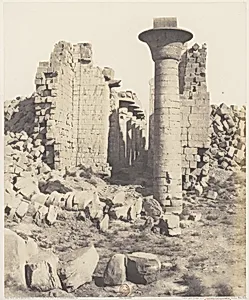
Karnak (Thèbes), Cour du Palais - Vue Prise de Point I
1851–52, printed 1853–54
Medium
Salted paper print from paper negative
Dimensions
30.7 x 25.2 cm. (12 1/16 x 9 15/16 in.)
Classification
Photographs
Department
Photographs
Museum
Metropolitan Museum of Art, New York, NY
Credit
Purchase, Lila Acheson Wallace Gift, 1976
Accession Number
1976.607.51
Rights
Public Domain
Tags
Art Historical Context
Step into the sun-drenched ruins of ancient Karnak with Félix Teynard's *Karnak (Thèbes), Cour du Palais Vue Prise de Point* (1851–52, printed 1853–). This salted paper print from a paper negative captures the majestic Court of the Palace at Thebes, showcasing towering columns and weathered stonework amid Egypt's vast archaeological wonders. Teynard, a pioneering French photographer and civil engineer, journeyed up the Nile in the early 1850s, documenting pharaonic monuments with unprecedented precision during Europe's Egyptomania craze. As one of the earliest photographic records of these sites, the image holds immense historical value. Created using the calotype process—invented by William Henry Fox Talbot—this medium allowed for detailed paper negatives that produced richly toned positives, revealing textures and shadows impossible in earlier drawings. Printed by Imprimerie Photographique de H. de Fonteny et Cie, it exemplifies mid-19th-century photography's role in archaeology, preserving Karnak's grandeur before erosion and excavation altered it forever. Today, housed in The Metropolitan Museum of Art (purchase, Lila Acheson Wallace Gift, 1976), this 30.7 x 25.2 cm gem invites us to ponder ancient Egypt's enduring legacy, bridging 5,000 years through light and chemistry.
About the Artist
Félix Teynard|Imprimerie Photographique de H. de Fonteny et Cie · 1817–1892
**Félix Teynard (1817–1892)** was a pioneering French photographer whose work captured the ancient wonders of Egypt and Nubia with unprecedented precision and artistry. Born on January 14, 1817, in Saint-Flour, he trained as a civil engineer in Grenoble, a hub of Egyptology that likely sparked his fascination with ancient architecture. Little is documented about his early life or formal photograph...