
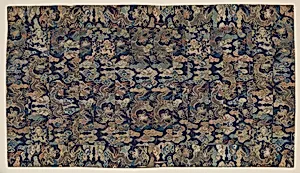
Kesa
1650/1700, Edo period (1615–1868)
Medium
Silk and gilt-paper strip; twill weave with secondary binding warp and supplementary patterning wefts
Dimensions
119.4 × 210.5 cm (47 × 82 7/8 in.)
Classification
textile
Department
Textiles
Museum
Art Institute of Chicago
Accession Number
183131
Rights
Public Domain
About this artwork
Given that Buddhism was introduced into Japan from China, and many Japanese priests and monks visited China as part of their training, it is understandable that the influence of China continued to be felt in Japan for centuries. Even during the Edo period, when Japan was all but closed to the outside world, there was still a reverence for things Chinese, as exemplified by the use of treasured Chinese fabric, perhaps once part of a robe, in this striking kesa. The five-clawed dragon indicates Chi...
About the Artist
Unknown
The artist designated as "Unknown" in our virtual museum's collection exemplifies a poignant chapter in art history: creators whose identities have faded into obscurity despite the enduring power of their work. With only one known artwork attributed to them in our holdings, this figure represents countless anonymous hands that shaped visual culture across centuries. Museums worldwide, including th...