
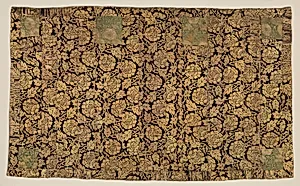
Kesa
17th century, Edo period (1615–1868)
Medium
Silk and gilt-paper strip; twill and satin weaves with secondary binding warps and supplementary patterning wefts
Dimensions
99.2 × 165.1 cm (39 × 65 in.); Warp repeat: H.: 44.2 cm (17 3/8 in.)
Classification
textile
Department
Textiles
Museum
Art Institute of Chicago
Accession Number
183145
Rights
Public Domain
About this artwork
The Chinese method for making gold "thread" out of paper coated with lacquer, finished with a layer of gold leaf, and cut into very fine strips was admired greatly by the Japanese but wasn't adopted in Japan until the late 16th century. Until then, and even after, Chinese textiles utilizing this kinran thread were imported into Japan. The term kinran is also applied to a specific type of textile made in Japan, usually at Nishijin, in Kyoto, that typically displays floral patterns in gold against...
About the Artist
Unknown
The artist designated as "Unknown" in our virtual museum's collection exemplifies a poignant chapter in art history: creators whose identities have faded into obscurity despite the enduring power of their work. With only one known artwork attributed to them in our holdings, this figure represents countless anonymous hands that shaped visual culture across centuries. Museums worldwide, including th...