
Key
Unknown Artist
1st–7th century
Medium
Copper alloy, iron
Dimensions
Overall: 3 11/16 x 1 7/16 x 7/8 in. (9.3 x 3.7 x 2.3 cm)
Classification
Metalwork-Bronze
Culture
Roman
Department
Medieval Art
Museum
Metropolitan Museum of Art, New York, NY
Credit
Purchase, De Souhami Collection, Rogers Fund, 1906
Accession Number
06.176.75
Rights
Public Domain
Art Historical Context
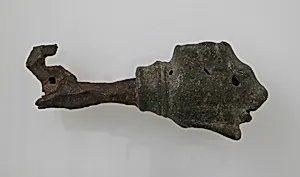
This unassuming yet intriguing Roman key, crafted by an unknown artist between the st and 7th CE, exemplifies everyday metalwork from the late Roman Empire into the early medieval period. just 3 11/ x 1 7/16 x 7/8 inches, it's fashioned from durable copper alloy—often akin to bronze—and iron materials prized for their strength and corrosion resistance. Acquired by The Metropolitan Museum of Art in1906 through the Dehami Collection and Rogers Fund, it now resides in the Medieval Art department, bridging classical antiquity and the Middle Ages. Keys like this were more than mere tools; they symbolized security, authority, and access in a world of locked homes, temples, and treasuries. Roman locksmiths employed sophisticated techniques, such as lost-wax casting for the copper alloy bow and shank, combined with forged iron bits for precise tumbler mechanisms—innovations that influenced lock designs for centuries. Its compact size suggests use for personal or household locks, highlighting the practical ingenuity of Roman craftsmanship amid expanding trade and urban life. Though simple, this artifact offers a tangible glimpse into daily Roman existence, where even utilitarian objects reflected metallurgical expertise. Visitors might ponder its journey through millennia, unlocking stories of ancient lives preserved in metal.