
Key
Unknown Artist
1st–3rd century
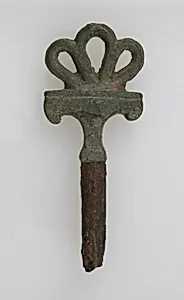
Medium
Copper alloy, iron
Dimensions
Overall: 3 7/16 x 1 7/16 x 5/8 in. (8.8 x 3.6 x 1.6 cm)
Classification
Metalwork-Bronze
Culture
Roman
Department
Medieval Art
Museum
Metropolitan Museum of Art, New York, NY
Credit
Rogers Fund, 1910
Accession Number
10.100.158
Rights
Public Domain
Art Historical Context
This unassuming yet intriguing Roman key, dating to the 1st–3rd century CE, a glimpse into the everyday ingenuity of the ancient world. Crafted from copper alloy—likely bronze—with iron components, it measures just 3 7/16 x 1 7/16 x 5/8 inches, enough to fit in a pocket or hang from a belt. Acquired by The Metropolitan Museum of Art through Rogers Fund in 191, it resides in the Medieval Art department, bridging the late Roman Empire with early medieval metalworking traditions. Roman keys like this one were essential tools for securing doors, chests, and gates, reflecting a society that valued privacy and property amid expanding trade and urban life. The combination of durable copper alloy for the handle and iron for the functional bits demonstrates advanced metallurgical techniques, such as casting and forging, which allowed for precise, interchangeable mechanisms. Though created by an unknown artisan, its survival highlights the Romans' mastery of functional design, where utility met subtle ornamentation. Today, this modest artifact captivates by revealing the mundane made monumental—proof that even the smallest objects can unlock stories of ancient innovation and daily existence.