
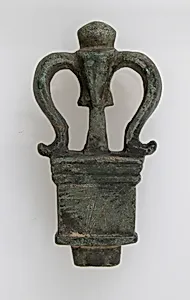
Key or Key Handle
Unknown Artist
1st–7th century
Medium
Copper alloy
Dimensions
Overall: 2 15/16 x 1 9/16 x 11/16 in. (7.5 x 3.9 x 1.7 cm)
Classification
Metalwork-Copper alloy
Culture
Roman
Department
Medieval Art
Museum
Metropolitan Museum of Art, New York, NY
Credit
Purchase, De Souhami Collection, Rogers Fund, 1906
Accession Number
06.176.1
Rights
Public Domain
Art Historical Context
This exquisite copper alloy *Key or Key Handle* the 1st–7th century offers a glimpse into everyday Roman life during a transformative era spanning the late Empire to early Byzantine influences. Measuring just under 3 inches long, small yet finely crafted object—likely part of a larger key—highlights the Romans' practical ingenuity in securing homes, treasures, and sacred spaces. Keys were potent symbols of authority and property, often carried by householders or entrusted to slaves, underscoring the society's emphasis on privacy and control amid expanding trade and urbanization. Crafted in durable copper alloy, a common medium for Roman metalwork due to its corrosion resistance and workability, the piece exemplifies skilled techniques like casting or hammering. Its compact form and potential ornamental details reflect the blend of utility and subtle artistry typical of Roman functional objects, bridging the gap between the classical world and emerging medieval traditions—hence its place in The Metropolitan Museum of Art's Medieval Art department. Acquired in 1906 through the Rogers Fund and De Souhami Collection, this artifact invites us to ponder the hands that once gripped it: a merchant locking his villa, a priest safeguarding temple relics, or a traveler protecting their wares. It's a humble survivor that speaks volumes about Roman resilience and craftsmanship.