
Key
Unknown Artist
15th–16th century
Medium
Iron
Dimensions
Overall: 5 7/8 x 2 1/2 x 1 9/16 in. (15 x 6.3 x 3.9 cm)
Classification
Metalwork-Iron
Culture
German
Department
Medieval Art
Museum
Metropolitan Museum of Art, New York, NY
Credit
Rogers Fund, 1910
Accession Number
10.100.66
Rights
Public Domain
Art Historical Context
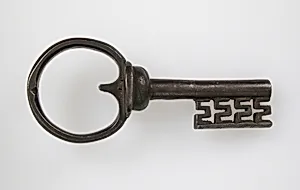
Step into the world of late medieval craftsmanship with this striking iron *Key* from 15th–16th Germany. Measuring 5 7/8 x 2 1/2 x 1 9/16 inches, this substantial artifact exemplifies the robust metalwork of its era, forged by an unknown artisan whose skill transformed everyday iron into a functional yet formidable object. Acquired through the Rogers Fund in 1910, it now graces the Medieval Art department at The Metropolitan Museum of Art. the context of German culture during this transitional period—bridging the Middle Ages and the Renaissance—keys like this one were essential for securing homes, chests, churches, or castles. Iron, valued for its durability and availability, was hammered and shaped through labor-intensive blacksmithing techniques, often involving heating, forging, and quenching to achieve strength without brittleness. This piece highlights the practical artistry of metalworkers, whose tools produced objects that balanced utility with subtle decorative flair, such as bowed handles or intricate bow designs inferred from surviving examples. Today, this unassuming key reveals the ingenuity of pre-industrial Europe, reminding us how mundane items encoded status and security. Its preservation underscores the Met's commitment to showcasing everyday treasures that illuminate daily life centuries ago.