
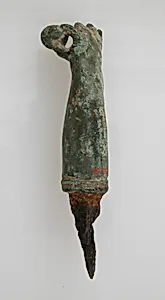
Key Handle
Unknown Artist
1st–7th century
Medium
Copper alloy
Dimensions
Overall: 2 9/16 x 13/16 x 5/8 in. (6.5 x 2.1 x 1.6 cm)
Classification
Metalwork-Copper alloy
Culture
Roman
Department
Medieval Art
Museum
Metropolitan Museum of Art, New York, NY
Credit
Purchase, De Souhami Collection, Rogers Fund, 1906
Accession Number
06.176.21
Rights
Public Domain
Art Historical Context
This exquisite copper alloy key handle, dating from the 1st to 7th century, hails from Roman culture and exemplifies the everyday artistry of the ancient world. Measuring just over 2½ inches long, its compact form suggests it was part of a functional key used in domestic or administrative settings. Acquired by the Metropolitan Museum of Art in 6 through the Rogers Fund and De Souh Collection, it now resides in the Medieval Art department bridging late antiquity's Roman legacy into early medieval traditions. In Roman society, keys were potent symbols of authority, privacy, and property ownership—often carried by women as badges of household management or by officials for securing temples and treasuries. This handle's survival highlights the durability of copper alloy metalwork, likely crafted through lost-wax casting or hammering techniques that allowed for intricate detailing on such small scales. Though the artist remains unknown, the object's refined execution reflects the high level of metallurgical skill in the Roman Empire, where utilitarian items were elevated by decorative flair. Visitors will appreciate how this unassuming artifact reveals the textures of daily Roman life, from bustling villas to imperial outposts, reminding us that beauty often hid in the practical. A testament to enduring craftsmanship, it invites us to unlock the secrets of antiquity.