
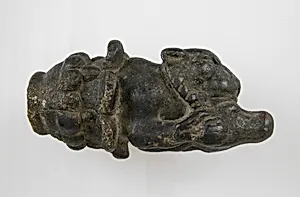
Key Handle
Unknown Artist
1st–7th century
Medium
Copper alloy
Dimensions
Overall: 3 3/4 x 1 13/16 x 1 5/8 in. (9.6 x 4.6 x 4.1 cm)
Classification
Metalwork-Copper alloy
Culture
Roman
Department
Medieval Art
Museum
Metropolitan Museum of Art, New York, NY
Credit
Purchase, De Souhami Collection, Rogers Fund, 1906
Accession Number
06.176.36
Rights
Public Domain
Art Historical Context
This delicate **Key Handle**, crafted by an unknown Roman artisan between the 1st and 7th centuries CE, offers a glimpse into the everyday artistry of the late Roman world. Fashioned from copper alloy—a durable, corrosion-resistant material ideal for functional objects—this small piece (just 3¾ inches long) was likely part of a larger key used for securing doors, chests, or sacred spaces. Its compact dimensions highlight the Romans' skill in creating portable, practical items with potential decorative flair. In Roman culture, keys transcended mere utility, often symbolizing authority, privacy, and even divine protection—think of the goddess Juno wielding a key to guard thresholds. Copper alloy metalwork like this was produced through sophisticated lost-wax casting techniques, allowing for intricate details on everyday tools. Spanning from the height of the Empire to early medieval transitions, this artifact bridges classical and emerging medieval traditions. Acquired in 1906 through the Rogers Fund and De Souhami Collection, it now resides in The Metropolitan Museum of Art's Medieval Art department, reminding us how Roman ingenuity in metalcraft influenced centuries of design. A humble yet evocative survivor of antiquity! (198 words)