
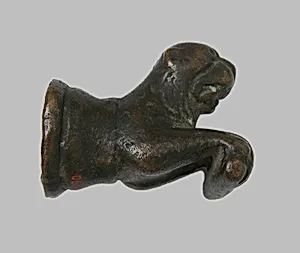
Key Handle
Unknown Artist
1st–7th century
Medium
Copper alloy
Dimensions
Overall: 1 5/16 x 1 x 11/16 in. (3.3 x 2.6 x 1.8 cm)
Classification
Metalwork-Bronze
Culture
Roman
Department
Medieval Art
Museum
Metropolitan Museum of Art, New York, NY
Credit
Purchase, De Souhami Collection, Rogers Fund, 1906
Accession Number
06.176.44
Rights
Public Domain
Art Historical Context
This delicate **Key Handle**, crafted from copper alloy (likely bronze) by an unknown Roman artisan between the 1st and 7th centuries, offers a glimpse into the everyday artistry of the late Roman world. Measuring just 1 5/16 x 1 x 11/16 inches, this petite metalwork piece would have adorned the end of a functional key, a practical tool into a symbol of status and craftsmanship. Acquired by The Metropolitan Museum of Art in1906 through the De Souhami Collection and Fund, it resides in the Medieval Art department bridging the gap between classical antiquity and the early medieval era. In Roman culture, keys held deep significance, often linked to household security, property ownership, and even religious rituals honoring the goddess Juno, protector of doors. Handles like this one were frequently cast or hammered with intricate details, showcasing advanced metalworking techniques such as lost-wax casting, which allowed for fine modeling despite the object's small scale. The use of durable copper alloy ensured longevity, highlighting Roman ingenuity in blending utility with aesthetic appeal. Though its exact form—perhaps featuring a loop, figure, or symbolic motif—remains subtly evocative, this artifact underscores the artistry embedded in daily life. Visitors, imagine unlocking ancient secrets with such a refined touch!