
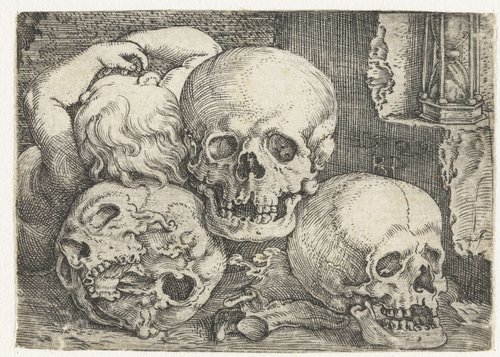
Kind met drie schedels
1529
Medium
engraving
Dimensions
42; 58
Rights
Public Domain
About this artwork
height 42 mm x width 58 mm
Art Historical Context
Barthel Beham’s 1529 engraving *Kind met drie schedels* (“Child with Three Skulls”) is a striking example of the small-scale prints produced by the so-called “Little Masters” of sixteenth-century Nuremberg. Measuring just 42 by 58 millimetres, the work demonstrates the remarkable precision possible in engraving, a medium that allowed artists to circulate detailed images widely and affordably during the early years of the Reformation. The composition presents a child alongside three skulls, a clear memento mori motif reminding viewers of life’s brevity. Such imagery was especially resonant in the late 1520s, when religious upheaval and recurring plague heightened awareness of mortality. Beham, trained in the circle of Albrecht Dürer, used fine line work and subtle tonal contrasts to convey both tenderness and solemnity within the tiny format. Despite its modest size, the print carries significant cultural weight. It reflects the Renaissance interest in moral instruction through art and shows how printmaking democratised complex themes once reserved for large paintings or church decorations.
About the Artist
Barthel Beham · 1502–1540
Barthel Beham (1502–1540), a pivotal figure in the German Renaissance, was born in Nuremberg into a family of artists. The younger brother of the renowned engraver Hans Sebald Beham, he honed his craft under the tutelage of his elder sibling and the master Albrecht Dürer, absorbing the precise techniques of engraving and painting that defined Nuremberg's vibrant artistic scene. Emerging as a prodi...