
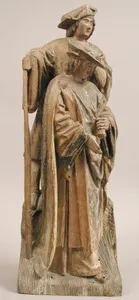
King Clothar II and an Attendant
Unknown Artist
ca. 1500–1525
Medium
Oak, painted
Dimensions
Overall: 21 1/2 x 7 5/8 x 5 in. (54.6 x 19.4 x 12.7 cm)
Classification
Sculpture-Wood
Culture
French
Department
Medieval Art
Museum
Metropolitan Museum of Art, New York, NY
Credit
Gift of George Blumenthal, 1941
Accession Number
41.100.189
Rights
Public Domain
Tags
Art Historical Context
Step into the world of late medieval France with *King Clothar II and an Attendant*, a carved oak sculpture from around 1500–1525. This portrait, standing just over 21 inches tall, captures the Merovingian king (r. 584–629)—a pivotal Frankish ruler who unified kingdoms and issued key legal reforms like the Edict of Paris—with a loyal attendant at his side. Painted to enhance its lifelike quality, the work reflects the era's blend of historical reverence and artistic skill, now housed in The Metropolitan Museum of Art's Medieval Art collection as a gift from George Blumenthal in 1941. Crafted from oak, a durable wood favored for its resistance to warping, the sculpture exemplifies Northern European techniques in polychrome wood carving. Artists layered paint over detailed carvings to convey texture in royal garments, facial expressions, and regal posture, bringing the distant past vividly to life. Though the creator remains unknown, such pieces often adorned private chapels, tombs, or scholarly collections, signaling a Renaissance curiosity about early medieval monarchs amid France's own dynastic pride. This rare survivor highlights the cultural bridge between Merovingian legacy and 16th-century identity, portraying Clothar not as myth but as a tangible sovereign. Visitors are drawn to its poised elegance, a testament to how art preserved history for generations.