
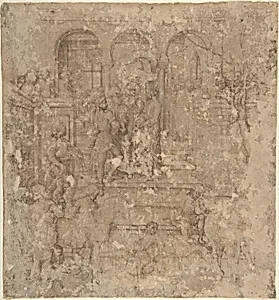
King Herod Receiving the Three Magi
second half of the 15th century
Medium
Pen and brown ink retouched with brush and gray ink, touches of white, and pen and black ink
Dimensions
11 5/8 x 10 13/16 in. (29.6 x 27.5 cm)
Classification
Drawings
Department
Drawings and Prints
Museum
Metropolitan Museum of Art, New York, NY
Credit
Gift of Cornelius Vanderbilt, 1880
Accession Number
80.3.486
Rights
Public Domain
Tags
Art Historical Context
In the grand tradition of late 15th-century Northern European, *King Herod Receiving the Three* captures a pivotal biblical moment from the Gospel Matthew. The three wise men, guided by a star, arrive at King Herod's court to inquire about the newborn "King of the Jews," unknowingly alerting the insecure ruler to a prophesied rival. Attributed to either Martin Schongauer or Israhel van Meckenem— masterful German draftsmen and engravers of the Late Gothic period—this drawing vividly animates the scene with kings, attendants, and even animals, evoking the opulent courts and spiritual narratives that captivated Renaissance audiences. Crafted with pen and brown ink, retouched with brush and gray ink, touches of white heightening, and black ink accents, the work showcases the era's innovative drawing techniques. These Northern artists excelled in intricate line work and subtle tonal modeling, bridging painting and printmaking. Schongauer, a pioneer in engraving, influenced generations, while Meckenem often emulated his style, blurring attributions in surviving sheets like this one (11 5/8 x 10 13/16 in.). Housed in the Metropolitan Museum of Art's Drawings and Prints department—a gift from Cornelius Vanderbilt in 1880—this piece highlights the cultural devotion to the Adoration of the Magi cycle, blending royal intrigue with divine prophecy. Its delicate medium reveals the artist's keen observation of architecture, costume, and gesture, offering visitors a window into the devotional artistry of medieval Europe.
About the Artist
Martin Schongauer|Israhel van Meckenem · 1435–1491
Martin Schongauer, born around 1450–1453 in Colmar, Alsace, emerged from a family of skilled artisans. The third of four or five sons of goldsmith Caspar Schongauer, who had relocated from Augsburg to Colmar around 1440, Martin was immersed in the goldsmith's trade from youth, likely receiving his initial training in his father's workshop—a common path for early engravers. He further honed his ski...