
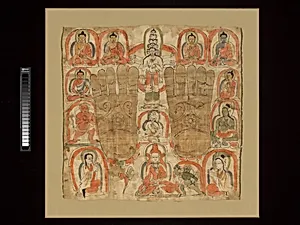
King Songten Gampo as the incarnate Avalokiteshvara
Unknown Artist
10th–11th century
Medium
Painting on silk
Dimensions
21 × 21 in. (53.3 × 53.3 cm)
Classification
Paintings
Culture
Tibet
Department
Asian Art
Museum
Metropolitan Museum of Art, New York, NY
Credit
Zimmerman Family Collection, Gift of the Zimmerman Family, in celebration of the Museum's 150th Anniversary, 2019
Accession Number
2019.291
Rights
Public Domain
Art Historical Context
This striking square painting on silk from 10th–11th century Tibet portrays King Songten Gampo the 7th-century ruler who unified the Tibetan plateau and laid the foundations of Buddhism in the region, as an earthly manifestation of Avalokiteshvara, the bodhisattva of compassion. In Tibetan tradition, such depictions affirm the king’s divine role as a protector and spiritual guide, linking political power with Buddhist ideals of mercy and enlightenment. The compact format suggests it may have served as a portable devotional object or temple offering. Painted with delicate mineral pigments on silk, the work reflects the refined techniques of early Tibetan Buddhist art, where luminous colors and precise iconography conveyed sacred narratives to viewers. Its square composition and intimate scale invite close contemplation, emphasizing the king’s serene, multi-armed form radiating compassion. Acquired by the Metropolitan Museum through the Zimmerman Family Collection, this rare survival offers a window into Tibet’s rich cultural synthesis of kingship and spirituality during a formative era.