
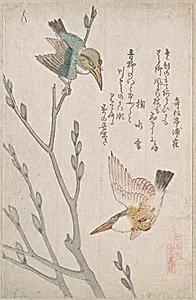
Kingfishers and Pussy-willow
19th century
Medium
Part of an album of woodblock prints (surimono); ink and color on paper
Dimensions
8 3/8 x 5 3/8 in. (21.3 x 13.7 cm)
Classification
Prints
Culture
Japan
Department
Asian Art
Museum
Metropolitan Museum of Art, New York, NY
Credit
H. O. Havemeyer Collection, Bequest of Mrs. H. O. Havemeyer, 1929
Accession Number
JP2285
Rights
Public Domain
Tags
Art Historical Context
In the delicate world of 19th-century Japanese wood prints, Kubo Shun *Kingfishers and P-willow* shines as a gem from a surimono album. Created during Japan's late Edo period, surimono were luxurious, privately commissioned prints often exchanged among poetry circles or as New Year's greetings. This intimate work, measuring just 8 3/8 x 5 3/8 inches, exemplifies the format's elegance, with vibrant ink and color on paper capturing nature's fleeting beauty. Shunman, a master of the ukiyo-e tradition, skillfully renders the iridescent plumage of kingfishers perched among the soft, budding branches of pussy-willow—a symbol of early spring renewal. The precise woodblock technique allowed for subtle gradations of color and fine details, evoking a sense of serene harmony between birds and blooming trees. These subjects reflect Japan's deep reverence for seasonal motifs in art, blending realism with poetic whimsy. Today, this print graces the Metropolitan Museum of Art's Asian Art department, part of the renowned H. O. Havemeyer Collection bequeathed in 1929. It invites visitors to appreciate the artistry of everyday wonder, bridging Edo-era refinement with timeless natural grace.
About the Artist
Kubo Shunman · 1757–1820
Japanese, 1757–1820