
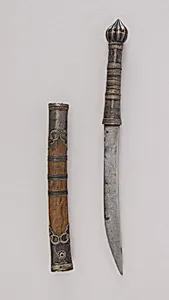
Knife (Dha) with Sheath
Unknown Artist
18th–19th century
Medium
Silver, wood, steel
Dimensions
H. with sheath 14 in. (35.6 cm); H. without sheath 13 1/4 in. (33.7 cm); W. 1 1/8 in. (2.9 cm); Wt. 4.7 oz. (133.2 g); Wt. of sheath 1.9 oz. (53.9 g)
Classification
Knives
Culture
Thai
Department
Arms and Armor
Museum
Metropolitan Museum of Art, New York, NY
Credit
Bequest of George C. Stone, 1935
Accession Number
36.25.808a, b
Rights
Public Domain
Art Historical Context
This exquisite Knife (Dha) with Sheath, crafted in Thailand during the 18th–19th century, exemplifies the masterful blend of functionality and artistry in Southeast Asian arms. Measuring 14 inches tall with its sheath, the weapon features a steel blade, a wooden handle, and intricate silver elements on the sheath, weighing a balanced 4.7 ounces without it. Such dhas were essential tools for Thai warriors, hunters, and nobility, valued not just for combat but as symbols of status and craftsmanship. In Thai culture, knives like this dha represented both practical utility and aesthetic refinement. The use of silver for decorative mounts highlights the silversmith's skill, often involving repoussé or chasing techniques to create ornate patterns that reflected royal or elite patronage. During this period, Thailand's Ayutthaya and early Rattanakosin eras saw flourishing metalwork traditions, where weapons doubled as heirlooms passed through generations. Now housed in the Metropolitan Museum of Art's Arms and Armor Department, thanks to the 1935 bequest of collector George C. Stone, this piece invites visitors to appreciate the cultural depth of Thai metallurgy and design—where beauty met lethality in everyday life.