
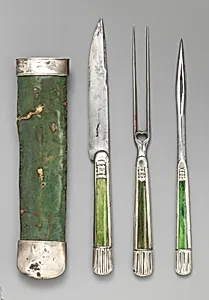
Knife, fork, and skewer needle with case
Unknown Artist
18th century
Medium
Steel, shagreen, silver, horn or ivory
Dimensions
Length (case .16a): 7 1/2 in. (19.1 cm); Length (knife .16b): 9 7/8 in. (25.1 cm); Length (fork .16c): 8 3/4 in. (22.2 cm); Length (skewer needle .16d): 8 1/4 in. (21 cm)
Classification
Metalwork-Steel
Culture
possibly Flemish
Department
European Sculpture and Decorative Arts
Museum
Metropolitan Museum of Art, New York, NY
Credit
Gift of R. Stuyvesant, 1891
Accession Number
91.16.16a–d
Rights
Public Domain
Art Historical Context
This elegant 18th-century traveling cutlery set, comprising a knife, fork, skewer, and fitted case, the refined craftsmanship of European arts, possibly from Flemish. Crafted from polished steel blades for the cutting tools, with handles of luxurious shagreen—a textured ray skin prized for its durability and grip—accented by silver mounts and horn or ivory grips, the set measures up to nearly 10 inches long. Housed in a compact case just 7½ inches, it was designed for portability, reflecting the era's emphasis on personal hygiene and sophistication during travel. In the 18th century, as table manners evolved among the European elite, owning a private cutlery set became a mark of status, sparing users from shared utensils at inns or banquets. The skewer needle, a specialized piercing tool, highlights practical innovation for spearing meats or fruits, while the shagreen and silver detailing underscore the blend of functionality and ornamentation in metalwork. Now in the Metropolitan Museum of Art's European Sculpture and Decorative Arts collection—gifted by R. Stuyvesant in 1891—this anonymous masterpiece reveals the artistry of unknown makers, whose techniques in etching, inlaying, and polishing transformed everyday objects into treasures of cultural refinement.