
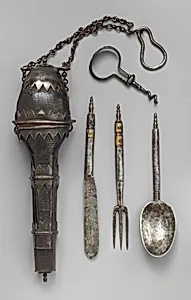
Knife, fork, spoon, and corkscrew in a case (Étui de couvert)
late 17th or 18th century
Medium
Steel, iron, partly inlaid with horn; leather
Dimensions
Length (knife): 6 5/8 in. (16.8 cm); Length (fork): 5 7/8 in. (14.9 cm); Overall (spoon): 5 7/8 × 1 1/2 in. (14.9 × 3.8 cm); Overall (corkscrew, open): 3 1/2 × 1 1/2 in. (8.9 × 3.8 cm); Overall (case, closed): 9 × 2 5/8 × 2 1/2 in. (22.9 × 6.7 × 6.4 cm)
Classification
Metalwork-Steel
Culture
probably French or Italian
Department
European Sculpture and Decorative Arts
Museum
Metropolitan Museum of Art, New York, NY
Credit
Gift of Joseph G. Reinis, 2011
Accession Number
2011.323.1a, b–.5
Rights
Public Domain
Art Historical Context
This exquisite *Étui de couvert*—a compact case containing a knife, fork, spoon, and corkscrew—dates to the late 17th or 18th century and likely hails from France or Italy. These portable dining sets were essential accessories for travelers, merchants, or nobility during the Baroque era, when refined table manners and mobility were hallmarks of elite culture. Encased in leather for protection, the set reflects the era's blend of practicality and elegance, allowing owners to dine properly even on the road. Crafted from steel and iron, with selective inlays of horn for decoration, the pieces showcase masterful metalwork techniques. The horn inlays add a subtle, tactile contrast to the durable metals, highlighting the artisan's skill in combining functionality with subtle ornamentation. Measuring just under 9 inches long when closed, the case's diminutive size underscores its travel-friendly design, while the corkscrew nods to the continent's growing wine culture. Housed in the Metropolitan Museum of Art's Department of European Sculpture and Decorative Arts, this anonymous masterpiece (gift of Joseph G. Reinis, 2011) offers a glimpse into everyday luxury, where even utensils became objects of artistry and status.
About the Artist
Anonymous
In the vast tapestry of art history, "Anonymous" stands not as a singular individual but as a collective designation for countless unidentified creators whose works have endured across millennia. These artists, spanning prehistoric cave painters to medieval illuminators and folk craftsmen, produced the foundational layers of human visual culture. Prior to the Renaissance, when individual fame emer...