
Knife Handle (Kozuka)
mid-18th century
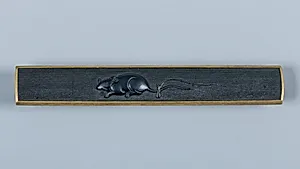
Medium
Copper-gold alloy (shakudō), silver
Dimensions
L. 3 13/16 in. (9.7 cm); W. 9/16 in. (1.4 cm)
Classification
Sword Furniture-Kozuka
Culture
Japanese
Department
Arms and Armor
Museum
Metropolitan Museum of Art, New York, NY
Credit
Rogers Fund, 1945
Accession Number
45.24.33
Rights
Public Domain
Art Historical Context
This exquisite *Knife Handle (Kozuka)*, by the renowned metalworker Gotō Mitsut (known as Enjō) in mid-18th-century Japan, exemplifies the pinnacle of Edo-period sword fittings. Measuring just under 4 inches long, this compact piece from the samurai's arsenal was part of a larger ensemble of sword mounts, reflecting the era's blend of martial utility and artistic refinement. Gotō Mitsutaka, the prestigious Gotō school of metalworkers, was celebrated for his mastery in creating functional yet opulent accessories for the warrior class. A *kozuka* served as a small utility knife tucked into the scabbard of a samurai sword, used for everyday tasks or as a backup weapon. Its presence underscores the samurai's dual role as both fighter and cultured aesthete, where even weapons were adorned with poetic motifs evoking nature, history, or mythology—though specific designs on this example highlight the subtlety prized in Japanese metalwork. Fashioned from *shakudō*—a copper-gold alloy that develops a rich, velvety black patina—accented with silver, the handle showcases advanced *taka-zogan* inlay techniques, where precious metals are hammered into precise incisions. This Rogers Fund acquisition at The Metropolitan Museum of Art invites visitors to appreciate how such "hidden" treasures embodied Japan's *wabi-sabi* aesthetic: beauty in imperfection, restraint, and enduring craftsmanship.