
Knife Handle (Kozuka)
Unknown Artist
ca. 1615–1868
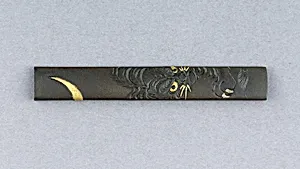
Medium
Copper-silver alloy (shibuichi), gold
Dimensions
L. 3 13/16 in. (9.7 cm); W. 9/16 in. (1.4 cm); thickness 3/16 in. (0.5 cm); Wt. 0.9 oz. (25.5 g)
Classification
Sword Furniture-Kozuka
Culture
Japanese
Department
Arms and Armor
Museum
Metropolitan Museum of Art, New York, NY
Credit
H. O. Havemeyer Collection, Bequest of Mrs. H. O. Havemeyer, 1929
Accession Number
29.100.1286
Rights
Public Domain
Tags
Art Historical Context
This exquisite *Knife Handle (Kozuka)*, in Japan during the Edo period (. 1615–1868), served as a functional yet artistic component of a samurai's sword ensemble. Inserted into the scabbard (saya) alongside the main blade, the kozuka held a small utility knife for tasks like sharpening or daily use. In an era of relative peace under the Tokug shogunate, such sword fittings evolved from practical armor into lavish displays of wealth and craftsmanship, blending utility with aesthetic refinement. Made from shibuichi—a copper-silver alloy prized for its subtle, smoky patina— the handle is adorned with gold inlays, a technique showcasing the meticulous *takabori* (high-relief carving) and *zōgan* (inlay) methods of Japanese metalworkers. Animal motifs, likely symbolic of strength or nature's harmony, reflect Edo-era fascination with fauna, drawing from folklore and Zen-inspired naturalism. Measuring just 3 13/16 inches long, its compact form highlights the precision of artisans who transformed everyday objects into wearable art. Part of the Metropolitan Museum of Art's Arms and Armor collection, gifted through the H. O. Havemeyer bequest in 1929, this piece invites visitors to appreciate Japan's fusion of martial tradition and delicate artistry. A testament to anonymous mastery, it whispers stories of samurai elegance across centuries.