
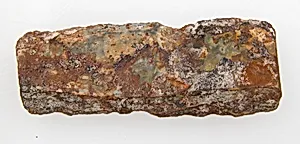
Knife Part
Unknown Artist
2500–1500 BCE; 4th–7th century CE
Medium
Flint (?)
Dimensions
Overall: 1 9/16 x 9/16 x 3/16 in. (4 x 1.4 x 0.5 cm)
Classification
Miscellaneous-Stone
Culture
Frankish
Department
Medieval Art
Museum
Metropolitan Museum of Art, New York, NY
Credit
Gift of J. Pierpont Morgan, 1917
Accession Number
17.191.111
Rights
Public Domain
Art Historical Context
This petite "Knife Part," crafted from flint, measures just 1 9/16 x 9/16 x 3/16 inches, a testament to the ingenuity of ancient toolmaking. Likely a blade fragment from a larger knife, its smooth, worked surfaces suggest skilled knapping techniques—chipping and pressure-flaking stone to create sharp edges. Housed in the Metropolitan Museum of Art's Medieval Art Department and classified as miscellaneous stone, it reflects the enduring utility of prehistoric materials in later eras. Dating spans two intriguing periods: originally from 2500–1500 BCE, during the Bronze Age when flint tools were vital for daily life, and later associated with the 4th–7th century CE Frankish culture. The Franks, early medieval Germanic peoples who shaped much of Europe under leaders like Clovis, often repurposed older artifacts, blending old technologies with their warrior society. This piece may represent such recycling, highlighting continuity in craftsmanship amid cultural shifts. A gift from J. Pierpont Morgan in 1917, it invites us to ponder the quiet stories embedded in small objects—how a simple tool traversed millennia, from ancient hands to a modern museum showcase.