
Dagger with Sheath
Unknown Artist
19th century
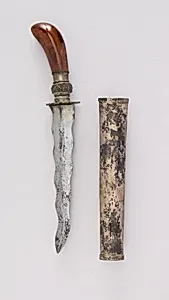
Medium
Steel, wood, silver, silver wire
Dimensions
H. with sheath 9 3/4 in. (24.8 cm); H. without sheath 9 5/16 in. (23.7 cm); H. of blade 6 in. (15.2 cm); W. 1 13/16 in. (4.6 cm); Wt. 3 oz. (7.6 g); Wt. of sheath 1.5 oz. (42.5 g)
Classification
Daggers
Culture
Philippine, Mindanao
Department
Arms and Armor
Museum
Metropolitan Museum of Art, New York, NY
Credit
Bequest of George C. Stone, 1935
Accession Number
36.25.871a, b
Rights
Public Domain
Art Historical Context
This exquisite *Dagger with Sheath* from 19th-century Mindanao, in the southern Philippines, exemplifies the region's renowned tradition of finely crafted edged weapons. Measuring just 9¾ inches with its sheath, the dagger features a steel blade about 6 inches long, paired with a hilt of wood adorned with silver and silver wire Weighing a mere 3 ounces without its 1.5-ounce sheath its compact form belies its lethal purpose, while the luxurious materials suggest it served not only as a weapon but also as a symbol of status among warriors. In Mindanao, a culturally diverse area influenced by Islamic traditions and precolonial craftsmanship, such daggers were essential tools for defense and combat during a turbulent era of Spanish colonial rule and Moro resistance. The use of silver wire for wrapping or inlay—common in Philippine bladesmithing—highlights skilled metalworking techniques that blended utility with artistry, often passed down through generations of artisans. Now housed in the Metropolitan Museum of Art's Arms and Armor Department, thanks to the 1935 bequest of collector George C. Stone, this piece offers a window into the martial heritage of the Philippines. Visitors can appreciate how its balanced design and decorative elements reflect both practical ingenuity and cultural pride.