
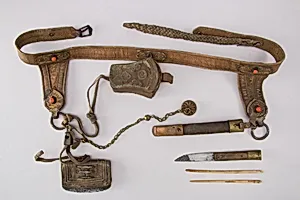
Knife with Sheath, Belt and Chopsticks
Unknown Artist
18th–19th century
Medium
Steel, leather, brass, copper, wood, ivory, coral
Dimensions
Knife (a); L. with sheath 10 3/8 in. (26.4 cm); L. without sheath 7 7/16 in. (18.9 cm); W. 7/8 in. (2.2 cm); Wt. 2.6 oz. (73.7 g); sheath (b) with belt; Wt. 1 lb. 6.4 oz. (635 g); chopsticks (c, d); L. 6 1/8 in. (15.6 cm); W. 1/4 in. (0.6 cm); Wt. 0.3 oz. (8.5 g)
Classification
Knives
Culture
Tibetan
Department
Arms and Armor
Museum
Metropolitan Museum of Art, New York, NY
Credit
Bequest of George C. Stone, 1935
Accession Number
36.25.1007a–d
Rights
Public Domain
Art Historical Context
This exquisite Tibetan *Knife with Sheath, Belt, and Chopsticks* from the 18th–19th century exemplifies the masterful craftsmanship of Himalayan artisans. Crafted from steel for the sharp blade, with a sheath and belt adorned in leather, brass, copper, wood, ivory, and coral, it measures about 10 inches long with its sheath. The inclusion of slender wooden chopsticks (6 inches long) transforms this into a multifunctional personal kit, blending utility with subtle luxury—ivory and coral hint at the status of its owner. In Tibetan culture, such knives were essential accessories for men, worn daily as symbols of readiness and identity amid the rugged high plateaus. Produced during a period of relative stability under Qing influence, these objects reflect nomadic traditions where edged tools served for defense, food preparation, and dining. The diverse materials showcase advanced metalworking and inlay techniques, with brass and copper adding durability and gleam, while organic elements like coral evoked spiritual protection. Now in the Metropolitan Museum of Art's Arms and Armor Department, thanks to the 1935 bequest of George C. Stone, this ensemble offers a window into everyday Tibetan life, where beauty and function intertwined seamlessly.