
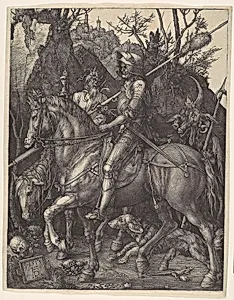
Knight, Death, and the Devil
1513
Medium
Engraving
Dimensions
Sheet: 9 13/16 x 7 11/16 in. (25 x 19.6 cm) Plate: 9 9/16 x 7 3/8 in. (24.3 x 18.8 cm)
Classification
Prints
Department
Drawings and Prints
Museum
Metropolitan Museum of Art, New York, NY
Credit
Harris Brisbane Dick Fund, 1943
Accession Number
43.106.2
Rights
Public Domain
Tags
Art Historical Context
Albrecht Dürer's 1513 engraving *Knight, Death, and the Devil* stands as a pinnacle of Northern Renaissance printmaking. The German master, renowned for his technical precision, used copper-plate engraving to achieve extraordinary detail through fine lines and hatching. This compact work—roughly 25 by 20 cm—demonstrates how the medium enabled artists to produce multiple, richly textured impressions that spread ideas across Europe. The scene shows a resolute knight on horseback, accompanied by a loyal dog, riding past the Devil and amid skulls that evoke mortality. These elements, drawn from the work's imagery of men, knights, horses, and demonic figures, create an allegory of steadfast faith amid life's perils. Dürer's style blends Northern attention to naturalistic texture with Renaissance harmony, turning a modest print into a profound meditation on courage and transience. Housed in the Metropolitan Museum of Art, the engraving remains a testament to Dürer's influence and the power of prints to convey complex human themes. Visitors today still marvel at its intricate craftsmanship and enduring symbolic depth.
About the Artist
Albrecht Dürer · 1471–1528
Albrecht Dürer (1471–1528) stands as the preeminent figure of the Northern Renaissance and arguably the most influential artist in the history of printmaking. Born in Nuremberg on May 21, 1471, and dying in the same city on April 6, 1528, Dürer revolutionized the status of the artist in Northern Europe, transforming printmaking from a commercial craft into an independent fine art and establishing ...