
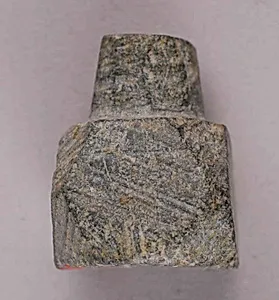
Knob
Unknown Artist
8th–13th century
Medium
Stone; carved
Dimensions
H. 13/16 in. (2 cm) W. 11/16 in. (1.7 cm) D. 5/8 in. (11.6 cm)
Classification
Stone
Department
Islamic Art
Museum
Metropolitan Museum of Art, New York, NY
Credit
Rogers Fund, 1948
Accession Number
48.101.236
Rights
Public Domain
Art Historical Context
This diminutive carved stone knob, dating from the 8th to 13th century, exemplifies exquisite craftsmanship of Islamic artisans during a golden era of cultural flourishing. Measuring just under an inch in height, width, and depth, was likely used as a functional yet decorative element—perhaps for furniture, doors, or vessels—in everyday life across the Islamic world, from the Abbasid heartlands to regional workshops. Crafted from stone through meticulous carving techniques, the knob reflects the mastery of Islamic stonework, where sculptors transformed hard materials into precise, tactile forms. Though its exact design details are subtle at this scale, such objects often featured incised patterns or smooth contours that hinted at broader motifs like arabesques or geometry, emphasizing harmony and restraint in Islamic aesthetics. Its survival speaks to the durability of these artifacts and the reverence for utilitarian beauty. Housed in the Metropolitan Museum of Art's Islamic Art department, acquired through the Rogers Fund in 1948, this unassuming piece invites us to appreciate how Islamic art elevated the ordinary. In a time of intellectual and artistic exchange, it connects us to anonymous makers whose skill bridged utility and artistry.