
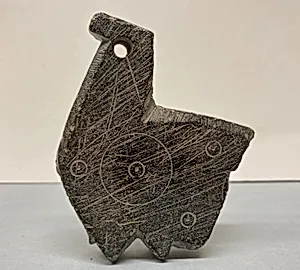
Fragment of a Cooking Spit
Unknown Artist
8th–13th century
Medium
Stone; carved
Dimensions
H. 2 5/8 in. (6.6 cm) W. 3 1/4 in. (8.2 cm) D. 5/16 in. (0.8 cm)
Classification
Stone
Department
Islamic Art
Museum
Metropolitan Museum of Art, New York, NY
Credit
Rogers Fund, 1948
Accession Number
48.101.245
Rights
Public Domain
Art Historical Context
### Fragment of a Cooking Spit delicate carved stone fragment, measuring just over 2½ inches high and remarkably thin at less than a third of an inch, captures a humble yet essential tool of daily life: part of a cooking spit used for roasting meat. Dating to the expansive Islamic world of the 8th–13th centuries—a period spanning the Abbasid Caliphate's golden age through turbulent Mongol incursions—it offers a rare glimpse into the mundane routines that sustained vibrant medieval societies from Spain to Central Asia. Crafted from stone through precise carving techniques, the fragment's slim profile suggests it may have been part of a larger decorative relief, architectural element, or even a domestic object like a vessel or tile. In Islamic art, such motifs often blended utility with artistry, elevating everyday scenes to celebrate abundance and hospitality central to the culture. Though the artist remains unknown, the meticulous workmanship highlights the skill of anonymous stone carvers who transformed hard material into evocative vignettes of life. Acquired through the Rogers Fund in 1948 and housed in The Metropolitan Museum of Art's Islamic Art department, this unassuming piece reminds us how art preserves the ordinary—inviting us to savor the flavors of history one spit-turn at a time. *(178 words)*