
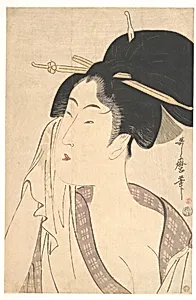
Woman Relaxing after Her Bath
1790s
Medium
Woodblock print; ink and color on paper
Dimensions
H. 14 5/8 in. (37.1 cm); W. 9 5/8 in. (24.4 cm)
Classification
Prints
Culture & Period
Japan · Edo period (1615–1868)
Department
Asian Art
Museum
Metropolitan Museum of Art, New York, NY
Credit
Rogers Fund, 1914
Accession Number
JP144
Rights
Public Domain
Tags
Art Historical Context
In the vibrant world of Edo-period Japan (1615–1868), Kitagawa Utamaro the ephemeral beauty of everyday life through his masterful ukiyo-e wood prints. Created in the 1790s, *Woman Relaxing after Her* exemplifies Utamaro's signature bijin-ga style—portraits of elegant women (bijin)—showcasing a serene female in a private, intimate moment. This print reflects the "floating world" (ukiyo-e) of urban pleasures in Edo (modern Tokyo), where artists celebrated the grace and sensuality of courtesans and ordinary women amid a booming commercial culture. Utamaro's genius lies in his innovative techniques: subtle gradations of color (mizu-e), achieved through intricate woodblock printing with multiple carved blocks for ink and pigments on paper. Measuring just 14⅝ × 9⅝ inches, this intimate format was designed for affordable enjoyment by the merchant class, making high art accessible. His fluid lines and luminous palettes convey texture—from damp skin to flowing robes—elevating the mundane into poetry. Housed in the Metropolitan Museum of Art's Asian Art collection (Rogers Fund, 1914), this work highlights Utamaro's influence on global art, inspiring Impressionists like Mary Cassatt. It invites visitors to ponder Japan's rich tradition of honoring feminine beauty and transience.
About the Artist
Kitagawa Utamaro · 1753–1806
Kitagawa Utamaro (c. 1753-1806) was one of the most celebrated masters of ukiyo-e woodblock printing, revolutionizing the art of bijin-ga (pictures of beautiful women) during Japan's Edo period. Born Kitagawa Ichitaro, his early life remains shrouded in mystery, with conflicting accounts placing his birth in Kyoto, Osaka, Yoshiwara in Edo (modern Tokyo), or Kawagoe in Musashi Province. Under the t...