
Kōrin Picture Album (Kōrin gafu) 光琳画譜
after 1826 (reprinted posthumously)
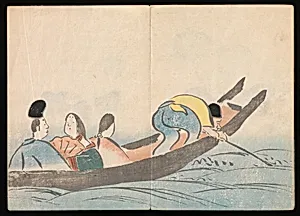
Medium
Woodblock printed book in two volumes (orihon, accordion-style); ink and color on paper
Dimensions
each: 10 5/8 × 7 11/16 in. (27 × 19.5 cm)
Classification
Illustrated Books
Culture & Period
Japan · Edo period (1615–1868)
Department
Asian Art
Museum
Metropolitan Museum of Art, New York, NY
Credit
Purchase, Mary and James G. Wallach Foundation Gift, 2013
Accession Number
2013.697a, b
Rights
Public Domain
Tags
Art Historical Context
This elegant woodblock-printed album, titled *Kōrin Picture Album* (*Kōrin gafu*), was created by the artist Nakamura Hōchū and first issued in the early nineteenth century, with this edition reprinted after 1826. Produced during Japan’s Edo period, the two-volume set takes the form of an *orihon*, or accordion-fold book, allowing pages to unfold like a continuous scroll. Its lively ink-and-color illustrations feature a delightful array of subjects—men and women, boats, cranes, deer, flowers, musicians, and games—capturing the playful spirit of everyday life and nature. Hōchū worked in the Rinpa tradition, drawing inspiration from the celebrated seventeenth-century painter Ogata Kōrin, whose name is honored in the album’s title. The woodblock medium enabled these refined designs to reach a broader audience beyond elite circles, blending fine-art aesthetics with the accessibility of printed books. Viewers today can appreciate the album’s rhythmic compositions and vibrant palette, which reflect the Rinpa emphasis on bold outlines, decorative patterns, and seasonal motifs. Acquired by the Metropolitan Museum of Art in 2013, this compact yet expansive work offers a window into Edo-period visual culture, where art, literature, and popular imagery intertwined. Its accordion format invites intimate, hands-on viewing, much as it would have delighted readers nearly two centuries ago.