
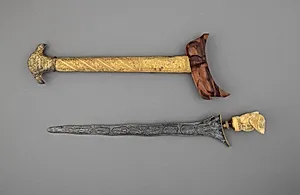
Kris with Sheath
Unknown Artist
16th–19th century
Medium
Steel, gold, ivory, wood, possibly diamonds
Dimensions
L. with sheath 18 1/8 in. (46 cm); L. without sheath 18 in. (45.7 cm); L. of blade 14 3/4 in. (37.5 cm); W. 3 in. (7.6 cm); Wt. 13.1 oz. (371.4 g); Wt. of sheath 7.2 oz. (204.1 g)
Classification
Krisses
Culture
Bornean
Department
Arms and Armor
Museum
Metropolitan Museum of Art, New York, NY
Credit
Bequest of George C. Stone, 1935
Accession Number
36.25.1268a, b
Rights
Public Domain
Art Historical Context
This exquisite *Kris with Sheath*, hailing from Borneo and dating to the 16th–19th century, exemplifies the masterful craftsmanship of Southeast Asian arms and armor. Crafted from steel for the wavy blade, with a hilt and sheath adorned in gold,, wood, and possibly, it measures 18⅛ inches (46 cm) overall. The asymmetrical, undulating blade—typical of krisses—is not just a weapon but a work of art, where the steel's intricate patterns likely result from folding and etching techniques that create mesmerizing damask-like effects. In Bornean culture, particularly among Dayak peoples, the kris transcended utility as a dagger for combat or ceremony; it symbolized status, power, and spiritual protection. Elite owners commissioned such opulent examples, with luxurious materials like ivory and gold signifying wealth and rank. The sheath's detailed ornamentation further elevated it as a wearable sculpture, often displayed in homes or worn during rituals. Now in the Metropolitan Museum of Art's Arms and Armor Department, thanks to the 1935 bequest of George C. Stone, this kris invites visitors to appreciate how weapons blended functionality, artistry, and mysticism in pre-colonial Borneo, offering a window into a vibrant warrior heritage.