
Krishna Fluting for the Gopis
Late 18th or early 19th century
Medium
Opaque watercolor, gold and tin alloy on paper
Dimensions
65 × 49.2 cm (25 5/8 × 19 3/8 in.)
Classification
painting
Department
Arts of Asia
Museum
Art Institute of Chicago
Accession Number
131815
Rights
Public Domain
About this artwork
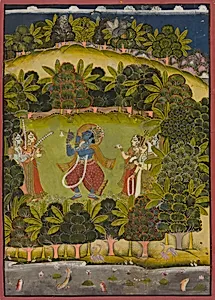
In a lush grove traversed by a silver stream filled with leaping fish and blooming lotuses, the blue-skinned Krishna woos his devoted gopis (female cowherds) by playing music on his bansuri (bamboo flute). The gopis’ infatuation with Krishna serves as a metaphor for the unconditional attachment (bhakti) of a devotee to their lord. Through personal adoration, they can attain union with the supreme deity. The theme of devotion is echoed in the pairs of waterfowl clustered around the river bank in ...
Art Historical Context
In the enchanting painting *Krishna Fluting for the G*, created in the late 18th or early 19th century, an artist captures a timeless scene from Hindu mythology. Krishna, the beloved blue-skinned deity and incarnation of Vishnu, plays his flute amidst a group of entranced gopis (milkmaids). This devotional motif, drawn from the *Bhagavata Purana*, symbolizes divine love and the soul's longing for union with the divine, a core theme in bhakti traditions that flourished in northern India during this era. Rendered in opaque watercolor heightened with gold and tin alloy on paper, the work exemplifies the exquisite techniques of Indian miniature painting. The luminous metals create a radiant glow, evoking otherworldly beauty, while the flat, vibrant colors and intricate details—flowing garments, jewelry, and natural landscapes—reflect the refined Pahari or Rajput styles prevalent in princely courts. Measuring 65 × 49.2 cm, its intimate scale invites close contemplation, much like manuscripts meant for royal patrons. Housed in the Art Institute of Chicago's Arts of Asia department, this painting offers a window into the cultural richness of pre-colonial India, where art intertwined spirituality, romance, and aesthetics to inspire devotion and wonder.
About the Artist
Unknown
The artist designated as "Unknown" in our virtual museum's collection exemplifies a poignant chapter in art history: creators whose identities have faded into obscurity despite the enduring power of their work. With only one known artwork attributed to them in our holdings, this figure represents countless anonymous hands that shaped visual culture across centuries. Museums worldwide, including th...