
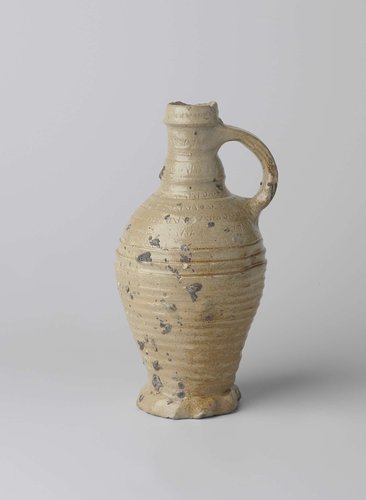
Kruik met draairingen
ca. 1500 - ca. 1549
Medium
turning
Dimensions
11.2; 12; 22.3; 8; 3.5
Rights
Public Domain
About this artwork
Kruik van steengoed. De hoge eivormige buik is geribd en bij de schouder geprofileerd. Op de schouder en hals gestempelde ornamenten.
Art Historical Context
### Kruik met Draairingen: A 16th-Century Stoneware Masterpiece Step into the world of Renaissance pottery with this elegant stoneware jug, or *kruik*, dating from around 1500 to 1549. Crafted anonymously by a skilled artisan, it stands at a graceful 22.3 cm tall with a slender 3.5 cm diameter, its high egg-shaped belly swelling elegantly before tapering to a profiled shoulder and neck. The subtlebing along the body—created through masterful wheel-throwing, or "turning"—gives it a rhythmic, almost textile-like texture, evoking the innovative techniques of early modern European potters. This piece exemplifies the stoneware tradition prominent in the Low Countries and Rhineland during the 16th century, where durable, non-porous ceramics revolutionized household goods. The stamped ornaments adorning the shoulder and neck add a touch of refinement, likely pressed with custom molds to create intricate patterns, blending functionality with subtle decoration. Such jugs were everyday essentials for serving liquids, yet their refined forms highlight the anonymous potter's expertise in form and surface treatment. In a virtual museum gallery, this jug whispers of bustling workshops and thriving trade routes, reminding us how ordinary objects carried artistic pride. Its survival speaks to stoneware's legendary toughness, a testament to craftsmanship that bridged utility and beauty in pre-industrial Europe.
About the Artist
anonymous
In the vast tapestry of art history, "Anonymous" stands not as a singular individual but as a collective designation for countless unidentified creators whose works have endured across millennia. These artists, spanning prehistoric cave painters to medieval illuminators and folk craftsmen, produced the foundational layers of human visual culture. Prior to the Renaissance, when individual fame emer...