
Küste (Seascape)
1916
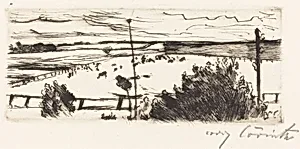
Medium
drypoint in black on wove paper
Dimensions
plate: 6.3 x 14.9 cm (2 1/2 x 5 7/8 in.) sheet: 16.2 x 25.3 cm (6 3/8 x 9 15/16 in.)
Classification
Department
CG-W
Museum
National Gallery of Art, Washington, D.C.
Credit
Gift of the Marcy Family in memory of Sigbert H. Marcy
Accession Number
1991.210.66
Rights
Public Domain
Art Historical Context
Lovis Corinth's *Küste (Seascape)*, in 1916, the dramatic beauty of the coastline in a compact drypoint print. A leading figure in German Impressionism who evolved toward Expressionism, Corinth was renowned for his bold, emotive landscapes and masterful printmaking. By 1916, amid World War I and his own health struggles following a stroke in 1911, his work grew more introspective and vigorous, infusing natural scenes with personal intensity. This intimate etching, measuring just 6.3 x 14.9 cm on the plate, exemplifies drypoint technique: Corinth scratched directly into the copper plate with a sharp needle, raising a soft burr that yields rich, velvety black lines on smooth wove paper. Unlike etched lines' crisp precision, drypoint's textured depth evokes the sea's restless energy—crashing waves, rugged cliffs—inviting viewers into a tactile seascape. Housed in the National Gallery of Art as a gift from the Marcy Family, *Küste* highlights Corinth's print legacy, bridging 19th-century traditions with modernist expressiveness. Its small scale belies its power, offering a window into an artist's resilient vision during turbulent times.
About the Artist
Lovis Corinth · 1858–1925
Lovis Corinth, born Franz Heinrich Louis on July 21, 1858, in Tapiau, East Prussia (now Gvardeysk, Russia), to a tanner father, displayed prodigious drawing talent from childhood. He began formal training at the Königsberg Academy in 1876, then moved to the Academy of Fine Arts in Munich from 1880 to 1884, studying under Ludwig von Löfftz and briefly Franz von Defregger, where he absorbed a Realis...