
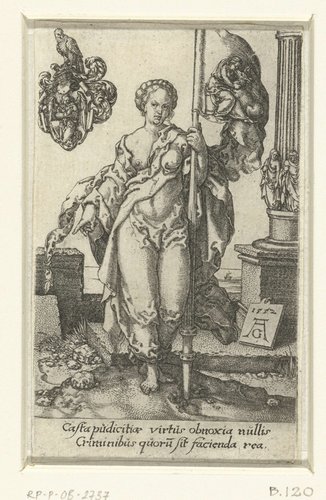
Kuisheid
Medium
engraving
Dimensions
102; 62
Rights
Public Domain
About this artwork
nummer, verso midden onder, handgeschreven: ‘110’
Art Historical Context
**Kuisheid (Chastity)** *Heinrich Aldegrever, 1552* *Engraving, 102 × 62 mm* Heinrich Aldegre, a prominent German engraver of the Northern Renaissance, created *Kuisheid*—Dutch for "Chastityin 1552. As one of the "Little," Aldegrever specialized in intricate small-scale prints, drawing inspiration from masters like Albrecht Dürer This delicate engraving likely belongs to a series personifying moral virtues, a popular theme in 16th-century Northern Europe, where such images served as moral guides amid the Reformation's religious upheavals. Engraving's technique shines here: Aldegrever incised fine lines into a copper plate, capturing Chastity's allegorical figure with exquisite detail in a compact 102 × 62 mm format. This medium revolutionized art dissemination, making high-quality imagery affordable to burghers and collectors beyond the elite. A handwritten "110" on the verso center-bottom hints at its cataloged history, perhaps from a 16th- or 17th-century collection. Culturally, *Kuisheid* reflects Renaissance humanism's blend of Christian ethics and classical ideals, promoting virtues like purity in daily life. Its survival underscores engraving's legacy as a bridge between painting and mass media, inviting us to admire Aldegrever's masterful precision up close.
About the Artist
Heinrich Aldegrever · 1502–1561
Heinrich Aldegrever, born in 1502 in Paderborn, Westphalia, to parents Herman and Katherine Trippenmeker—a family of clog-makers known by the dialect name Trippenmecker—emerged as a multifaceted artist in the German Renaissance. His early training remains undocumented, though he likely apprenticed in a Soest goldsmith's workshop after relocating there around 1525, where he joined the painters' gui...