
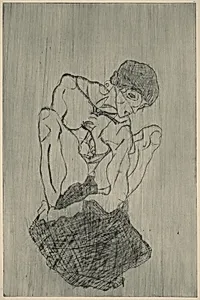
Kummernis (Sorrow)
published 1922
Medium
drypoint
Classification
Portfolio
Department
CG-W
Museum
National Gallery of Art, Washington, D.C.
Credit
Ailsa Mellon Bruce Fund
Accession Number
1971.65.4
Rights
Public Domain
Art Historical Context
Egon Schiele's *Kummernis (S)*, a poignant drypoint print published in 1922, the raw emotional intensity that defined the Austrian Expressionist's brief but brilliant career. Schiele, a protégé of Gustav Klimt and key figure in the Vienna Secession, often depicted distorted figures wracked by inner turmoil, reflecting the anxieties of early 20th-century Europe amid World War I and personal hardships. Tragically, Schiele died in 8 at age 28 from the Spanish flu pandemic, making this posthumous publication a testament to his enduring legacy. Rendered in drypoint—a direct intaglio technique where the artist scratches lines into a metal plate, raising a soft burr for velvety, textured ink deposits—the work exemplifies Schiele's mastery of line. His jagged, expressive strokes convey profound sorrow, evoking the folkloric figure of Kummernis, a sorrowful Madonna, while aligning with Expressionism's focus on psychological depth over realism. Acquired through the Ailsa Mellon Bruce Fund for the National Gallery of Art's portfolio collection (Department CG-W), *Kummernis* highlights Schiele's innovative printmaking, bridging painting's immediacy with the reproducibility of graphics. For visitors, it offers a visceral glimpse into an artist's unflinching exploration of human vulnerability.
About the Artist
Egon Schiele · 1890–1918
Egon Schiele (1890-1918) stands as one of the most provocative and psychologically penetrating artists of early twentieth-century European modernism. Born in Tulln an der Donau, Austria-Hungary, Schiele's brief but intensely productive life ended tragically at age twenty-eight when he and his pregnant wife Edith succumbed to the Spanish flu pandemic, mere days apart. Despite his truncated career, ...