
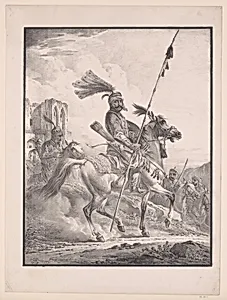
Kurd in military armor on horseback
Medium
Lithograph
Dimensions
Sheet: 24 3/4 × 18 7/16 in. (62.8 × 46.9 cm) Image: 20 9/16 × 16 5/16 in. (52.2 × 41.4 cm)
Classification
Prints
Department
Drawings and Prints
Museum
Metropolitan Museum of Art, New York, NY
Credit
Harris Brisbane Dick Fund, 1934
Accession Number
34.98.1
Rights
Public Domain
Art Historical Context
Step into the vivid world of early 19th-century lithography Aleksandr Orlovsky *Kurd in military on horseback* (1819). This print captures a fierce Kurdish warrior astride his steed, clad in ornate armor that evokes the rugged terrains of the Caucasus region. Orlov, a Polish-born Russian artist renowned for his dynamic battle scenes and caricatures, infused his work with the Romantic spirit of the era—celebrating heroism, exoticism, and the thrill of warfare amid Europe's post-Napoleonic fascination with distant cultures. Created as a lithograph, a revolutionary printing technique perfected around 1798 that allowed artists to draw directly on stone for mass reproduction, this piece measures an impressive sheet size of 24 3/4 × 18 7/16 inches. The medium's fluidity shines in Orlovsky's fluid lines and dramatic shading, bringing the rider's poised energy to life. Dating to 1819, it reflects Russia's imperial expansions into Persian and Ottoman territories, where Kurdish horsemen were both allies and adversaries, romanticized as noble savages in European art. Housed in the Metropolitan Museum of Art's Drawings and Prints department (Harris Brisbane Dick Fund, 1934), this work highlights lithography's role in democratizing art, making grand military portraits accessible to a wide audience. It's a window into how 19th-century viewers imagined the "wild East," blending cultural curiosity with artistic bravado.