
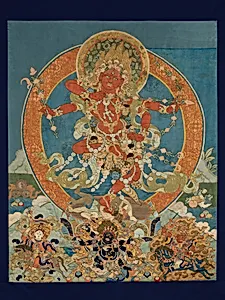
Kurukulla
Unknown Artist
19th century
Medium
Appliqued satin, brocade and damask, embroidered silk and painted details
Dimensions
Image: 56 × 47 in. (142.2 × 119.4 cm) Framed: 63 × 54 in. (160 × 137.2 cm)
Classification
Paintings
Culture
Tibet
Department
Asian Art
Museum
Metropolitan Museum of Art, New York, NY
Credit
Zimmerman Family Collection, Gift of the Zimmerman Family, 2014
Accession Number
2014.720.1
Rights
Public Domain
Tags
Art Historical Context
This striking 19th appliqué from Tibet depicts Kurukulla a revered Buddhist goddess associated with compassion and spiritual attraction. Created in a culture where religious imagery served both devotional and meditative purposes, the work would likely have been displayed in a monastery or household shrine. Its large scale—over four feet tall—suggests it was intended as a focal point for collective worship or ritual practice within Tibetan Buddhist communities. The artwork’s medium is particularly noteworthy. Skilled artisans layered and stitched luxurious fabrics including satin, brocade, and damask, then enhanced the surface with delicate silk embroidery and painted details. This labor-intensive technique allowed for brilliant color contrasts and a rich, tactile quality that painted thangkas could not achieve, while also making the piece more durable for repeated use in sacred spaces. As a gift to the Metropolitan Museum from the Zimmerman Family, this piece preserves a vital example of Tibetan textile artistry. It reflects the deep integration of art, faith, and craftsmanship that characterized Himalayan Buddhist traditions during the 19th century.