
L'Algérienne
1860s
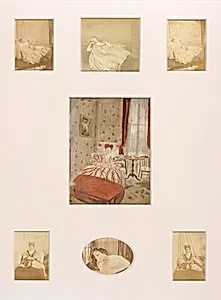
Medium
Albumen silver print from glass negative
Dimensions
10.5 x 11.4 cm (4 1/8 x 4 1/2 in.)
Classification
Photographs
Department
Photographs
Museum
Metropolitan Museum of Art, New York, NY
Credit
David Hunter McAlpin Fund, 1975
Accession Number
1975.548.62
Rights
Public Domain
Art Historical Context
**L'Algérienne**, a captivating albumen silver print by French photographer Pierre-Louis Pierson the 1860s, captures the allure of mid-19th-century portraiture. Measuring just 10.5 x 11.4 cm, this intimate image exemplifies the carte de visite format popularized by Pierson's associate, André-Adolphe-Eugène Disdéri. Produced from a glass negative, the albumen process—using egg whites to bind light-sensitive silver salts—yielded the era's richest, most detailed prints with warm tones and fine gradations, making photography accessible to a wide audience. Created during France's colonial era in Algeria, following the 1830 conquest, the work reflects the Orientalist fascination with North African cultures. Pierson, renowned for his elegant portraits of Parisian high society and Empress Eugénie, here turns his lens to an "exotic" subject, blending studio artistry with imperial intrigue. Such images fueled Europe's romanticized view of the "Orient," serving as collectible souvenirs that bridged art and emerging mass media. Today, housed in The Metropolitan Museum of Art's Photographs Department (David Hunter McAlpin Fund, 1975), *L'Algérienne* highlights photography's role in shaping cultural narratives. Visitors are invited to ponder how this small print encapsulated a world's gaze—elegant, evocative, and emblematic of its time.
About the Artist
Pierre-Louis Pierson · 1822–1913
Pierre-Louis Pierson (1822–1913) was a pioneering French portrait photographer whose career spanned the formative years of the medium. Born on December 13, 1822, in Hinckange in the Moselle department, Pierson developed an early fascination with photography during the 1840s, as the daguerreotype was still in its infancy. His early life and formal training remain sparsely documented, but by 1844, h...