
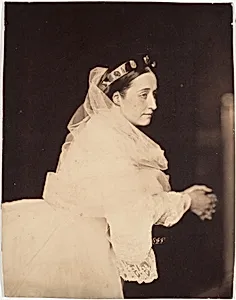
L'impératrice Eugénie en prière
1856
Medium
Albumen silver print from a collodion glass negative
Dimensions
Image: 23.4 x 18.3 cm (9 3/16 x 7 3/16 in.) Mount: 40.1 × 27.5 cm (15 13/16 × 10 13/16 in.)
Classification
Photographs
Department
Photographs
Museum
Metropolitan Museum of Art, New York, NY
Credit
Gilman Collection, Purchase, Harriette and Noel Levine Gift, 2005
Accession Number
2005.100.258
Rights
Public Domain
Tags
Art Historical Context
In 1856, French photographer Gustave Le Gray capturedL'impératrice Eug en prière* (Empress Eugénie in), a poised profile portrait of Napoleon III's empress consort. Eugénie de Montijo, known for her elegance and influence during the Second French Empire, depicted in a moment of quiet devotion, her features softly illuminated against a dark background. This albumen silver print, made from a collodion negative, exemplifies the era's cutting-edge wet-plate process, which Le Gray helped pioneer for its sharp detail and tonal richness. Le, a leading figure in mid-19th-century photography and founder of Paris's first photography school, elevated the medium from mere documentation to fine art. His technical mastery shines here: the collodion negative produced exquisite clarity on the albumen paper, capturing the subtle textures of Eugénie's lace veil and serene expression. At 23.4 x 18.3 cm, the intimate scale invites close contemplation, much like a painted miniature. This photograph holds cultural weight as one of the earliest regal portraits in photography, signaling the medium's rise in official and artistic circles. Housed in The Metropolitan Museum of Art's Gilman Collection, it reflects Eugénie's devout public image amid France's opulent imperial years, blending piety, portraiture, and photographic innovation.
About the Artist
Gustave Le Gray · 1820–1884
Gustave Le Gray, born on August 30, 1820, in Villiers-le-Bel near Paris to a prosperous merchant family, pursued his artistic ambitions against his parents' wishes for a legal career. As an only child, he trained as a painter in the studios of François-Édouard Picot and Paul Delaroche at the École des Beaux-Arts, exhibiting at the Paris Salons in 1848 and 1853. In 1844, he married Palmira Leonardi...