
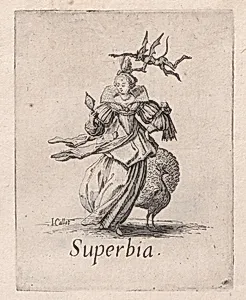
L'Orgueil (Pride), From Les Péchées Capitaux (The Deadly Sins)
ca. 1620
Medium
Etching and engraving; second state of four (Lieure)
Dimensions
Sheet: 7 5/16 x 10 5/16 in. (18.5 x 26.2 cm) Plate: 2 15/16 x 2 5/16 in. (7.5 x 5.8 cm)
Classification
Prints
Department
Drawings and Prints
Museum
Metropolitan Museum of Art, New York, NY
Credit
Bequest of Edwin De T. Bechtel, 1957
Accession Number
57.650.390(2)
Rights
Public Domain
Art Historical Context
Jacques Callot's *L'Orgueil (Pride)*, created around 1620, is a masterful etching and engraving from the *Les Péchés Capitaux (The Deadly Sins)*. This second state of four captures the sin of Pride through Callot's signature intricate compositions, likely teeming with figures in exaggerated poses of vanity and hubris—hallmarks of the Baroque era's moralistic art. As a leading French printmaker of the early 17th century, Call drew from Counter-Reformation themes, using prints to disseminate vivid warnings against human vices to a wide audience beyond elite patrons. The artwork's diminutive plate size (just 2 15/16 x 2 5/16 inches) belies its technical brilliance. Callot pioneered fine etching techniques, combining them with engraving for unprecedented detail in tiny spaces, allowing affordable reproduction. This series exemplifies his genius for crowded, narrative scenes, influencing later artists like Goya. Housed in the Metropolitan Museum of Art's Drawings and Prints department through the 1957 bequest of Edwin De T. Bechtel, it invites visitors to ponder Pride's timeless allure amid Callot's delicate lines.
About the Artist
Jacques Callot · 1592–1635
Jacques Callot (1592–1635) was a French printmaker and draftsman from the Duchy of Lorraine, widely regarded as one of the first great artists to practice the graphic arts exclusively. His more than 1,400 etchings chronicled the breadth of 17th-century life, from Medici court festivities to the brutal realities of warfare. Callot revolutionized etching through technical innovations including the é...