
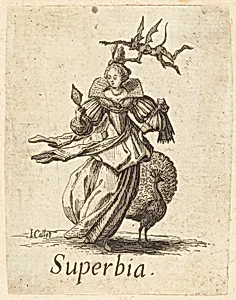
Pride (Vanity)
probably after 1621
Medium
etching and engraving on laid paper
Dimensions
sheet (trimmed to plate mark): 6.7 × 5.2 cm (2 5/8 × 2 1/16 in.)
Classification
Department
CG-E
Museum
National Gallery of Art, Washington, D.C.
Credit
R.L. Baumfeld Collection
Accession Number
1969.15.391
Rights
Public Domain
Art Historical Context
Jacques Callot's *Pride (Vanity)*, an exquisite etching and engraving from probably after 1621, captures the essence of one of the Seven Deadly Sins with dramatic flair. As a leading French printmaker of the early Baroque period, Callot was renowned for his intricate, morally charged series, and this small-scale work (just 6.7 × 5.2 cm) likely belongs to his depictions of human vices. Created during a time of religious fervor and social upheaval in 17th-century Europe, it reflects the era's obsession with moral allegory, warning viewers against the perils of excessive pride through vivid, theatrical imagery. Callot's mastery shines in his combined etching and engraving technique on laid paper, allowing for extraordinarily fine lines and textures that convey movement and emotion in a compact format. Etching offered fluid, spontaneous lines, while engraving added precision and depth, making his prints highly sought after by collectors. This intimate size suited private contemplation, turning the print into a portable moral lesson. Housed in the National Gallery of Art's R.L. Baumfeld Collection, *Pride (Vanity)* exemplifies Callot's influence on printmaking, bridging Mannerism's elegance with Baroque intensity. It's a reminder of art's power to probe the human soul, inviting us to reflect on vanity's timeless allure.
About the Artist
Jacques Callot · 1592–1635
Jacques Callot (1592–1635) was a French printmaker and draftsman from the Duchy of Lorraine, widely regarded as one of the first great artists to practice the graphic arts exclusively. His more than 1,400 etchings chronicled the breadth of 17th-century life, from Medici court festivities to the brutal realities of warfare. Callot revolutionized etching through technical innovations including the é...